Object Pool Pattern
Mostly, performance is the key issue during the software development and the object creation, which may be a costly step.
Object Pool Pattern says that ” to reuse the object that are expensive to create”.
Basically, an Object pool is a container which contains a specified amount of objects. When an object is taken from the pool, it is not available in the pool until it is put back. Objects in the pool have a lifecycle: creation, validation and destroy
A pool helps to manage available resources in a better way. There are many using examples: especially in application servers there are data source pools, thread pools etc.
Advantage of Object Pool design pattern
- It boosts the performance of the application significantly.
- It is most effective in a situation where the rate of initializing a class instance is high.
- It manages the connections and provides a way to reuse and share them.
- It can also provide the limit for the maximum number of objects that can be created.
Usage:
- When an application requires objects which are expensive to create. Eg: there is a need of opening too many connections for the database then it takes too longer to create a new one and the database server will be overloaded.
- When there are several clients who need the same resource at different times.
NOTE: Object pool design pattern is essentially used in Web Container of the server for creating thread pools and data source pools to process the requests.
Example of Object Pool Pattern:
Let’s understand the example by the given UML diagram.
UML for Object Pool Pattern
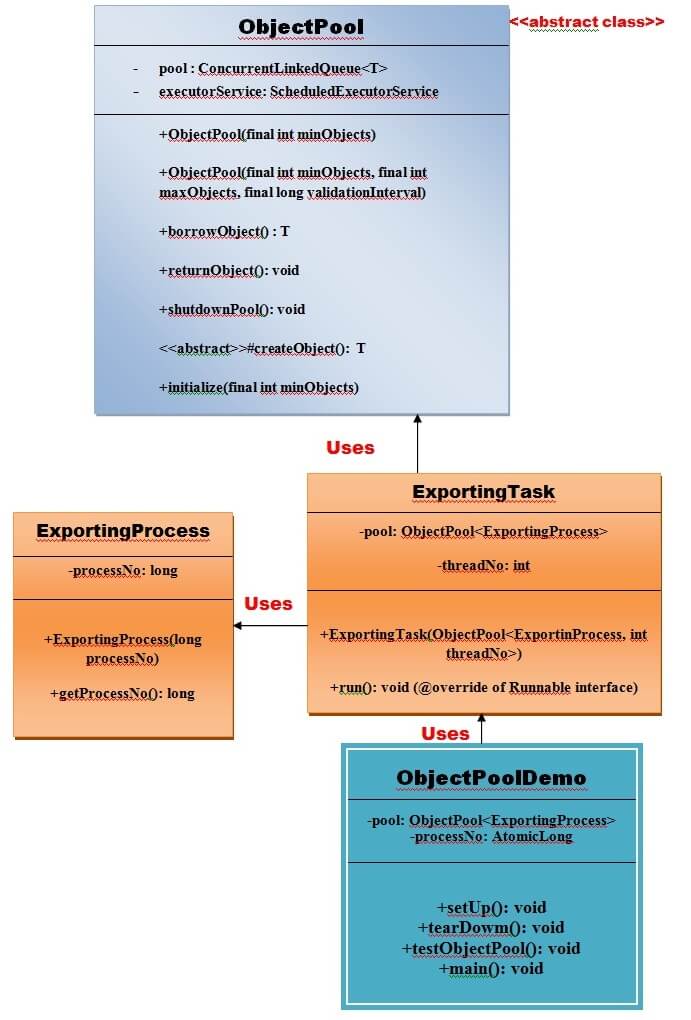
Implementation of above UML:
Step 1
Create an ObjectPool class that is used to create the number of objects.
import java.util.concurrent.ConcurrentLinkedQueue;
import java.util.concurrent.Executors;
import java.util.concurrent.ScheduledExecutorService;
import java.util.concurrent.TimeUnit;
public abstract class ObjectPool<T> {
/*
* pool implementation is based on ConcurrentLinkedQueue from the
* java.util.concurrent package. ConcurrentLinkedQueue is a thread-safe queue
* based on linked nodes. Because the queue follows FIFO technique
* (first-in-first-out).
*/
private ConcurrentLinkedQueue<T> pool;
/*
*
* ScheduledExecutorService starts a special task in a separate thread and
* observes the minimum and maximum number of objects in the pool periodically
* in a specified time (with parameter validationInterval). When the number of
* objects is less than the minimum, missing instances will be created. When the
* number of objects is greater than the maximum, too many instances will be
* removed. This is sometimes useful for the balance of memory consuming objects
* in the pool.
*/
private ScheduledExecutorService executorService;
/*
* Creates the pool.
*
* @param minObjects : the minimum number of objects residing in the pool
*/
publicObjectPool(final int minObjects) {
// initialize pool
initialize(minObjects);
}
/*
* Creates the pool.
*
* @param minObjects: minimum number of objects residing in the pool.
*
* @param maxObjects: maximum number of objects residing in the pool.
*
* @param validationInterval: time in seconds for periodical checking of
* minObjects / maxObjects conditions in a separate thread. When the number of
* objects is less than minObjects, missing instances will be created. When the
* number of objects is greater than maxObjects, too many instances will be
* removed.
*/
public ObjectPool(final int minObjects, final int maxObjects, final long validationInterval) {
// initialize pool
initialize(minObjects);
// check pool conditions in a separate thread
executorService = Executors.newSingleThreadScheduledExecutor();
executorService.scheduleWithFixedDelay(new Runnable() // annonymous class
{
@Override
publicvoidrun() {
int size = pool.size();
if (size < minObjects) {
int sizeToBeAdded = minObjects + size;
for (int i = 0; i < sizeToBeAdded; i++) {
pool.add(createObject());
}
} else if (size > maxObjects) {
int sizeToBeRemoved = size – maxObjects;
for (int i = 0; i < sizeToBeRemoved; i++) {
pool.poll();
}
}
}
}, validationInterval, validationInterval, TimeUnit.SECONDS);
}
/*
* Gets the next free object from the pool. If the pool doesn’t contain any
* objects, a new object will be created and given to the caller of this method
* back.
*
* @return T borrowed object
*/
public T borrowObject() {
T object;
if ((object = pool.poll()) == null) {
object = createObject();
}
returnobject;
}
/*
* Returns object back to the pool.
*
* @param object object to be returned
*/
public void returnObject(T object) {
if (object == null) {
return;
}
this.pool.offer(object);
}
/*
* Shutdown this pool.
*/
publicvoidshutdown() {
if (executorService != null) {
executorService.shutdown();
}
}
/*
* Creates a new object.
*
* @return T new object
*/
protectedabstractT createObject();
privatevoidinitialize(final int minObjects) {
pool = new ConcurrentLinkedQueue<T>();
for (int i = 0; i < minObjects; i++) {
pool.add(createObject());
}
}
}// End of the ObjectPool Class.
Step 2
Create an ExportingProcess class that will be used by ExportingTask class.
public class ExportingProcess {
privatelongprocessNo;
public ExportingProcess(long processNo) {
this.processNo = processNo;
// do some expensive calls / tasks here in future
// ………
System.out.println(“Object with process no. ” + processNo + ” was created”);
}
public long getProcessNo() {
return processNo;
}
}// End of the ExportingProcess class.
Step 3
Create an ExportingTask class that will use ExportingProcess and ObjectPool class.
public class ExportingTask implements Runnable {
private ObjectPool<ExportingProcess> pool;
privateintthreadNo;
public ExportingTask(ObjectPool<ExportingProcess> pool, int threadNo) {
this.pool = pool;
this.threadNo = threadNo;
}
publicvoidrun() {
// get an object from the pool
ExportingProcess exportingProcess = pool.borrowObject();
System.out.println(“Thread ” + threadNo + “: Object with process no. ” + exportingProcess.getProcessNo()
+ ” was borrowed”);
// you can do something here in future
// ………
// return ExportingProcess instance back to the pool
pool.returnObject(exportingProcess);
System.out.println(“Thread ” + threadNo + “: Object with process no. ” + exportingProcess.getProcessNo()
+ ” was returned”);
}
}// End of the ExportingTask class.
Step 4
Create an ObjectPoolDemo class
import java.util.concurrent.ExecutorService;
import java.util.concurrent.Executors;
import java.util.concurrent.TimeUnit;
import java.util.concurrent.atomic.AtomicLong;
public class ObjectPoolDemo {
private ObjectPool<ExportingProcess> pool;
private AtomicLong processNo = new AtomicLong(0);
publicvoidsetUp() {
// Create a pool of objects of type ExportingProcess.
/*
* Parameters: 1) Minimum number of special ExportingProcess instances residing
* in the pool = 4 2) Maximum number of special ExportingProcess instances
* residing in the pool = 10 3) Time in seconds for periodical checking of
* minObjects / maxObjects conditions in a separate thread = 5. –>When the
* number of ExportingProcess instances is less than minObjects, missing
* instances will be created. –>When the number of ExportingProcess instances
* is greater than maxObjects, too many instances will be removed. –>If the
* validation interval is negative, no periodical checking of minObjects /
* maxObjects conditions in a separate thread take place. These boundaries are
* ignored then.
*/
pool = new ObjectPool<ExportingProcess>(4, 10, 5) {
protected ExportingProcess createObject() {
// create a test object which takes some time for creation
return new ExportingProcess(processNo.incrementAndGet());
}
};
}
publicvoidtearDown() {
pool.shutdown();
}
public void testObjectPool() {
ExecutorService executor = Executors.newFixedThreadPool(8);
// execute 8 tasks in separate threads
executor.execute(new ExportingTask(pool, 1));
executor.execute(new ExportingTask(pool, 2));
executor.execute(new ExportingTask(pool, 3));
executor.execute(new ExportingTask(pool, 4));
executor.execute(new ExportingTask(pool, 5));
executor.execute(new ExportingTask(pool, 6));
executor.execute(new ExportingTask(pool, 7));
executor.execute(new ExportingTask(pool, 8));
executor.shutdown();
try{
executor.awaitTermination(30, TimeUnit.SECONDS);
} catch (InterruptedException e)
{
e.printStackTrace();
}
}
publicstaticvoidmain(String args[]) {
ObjectPoolDemoop = new ObjectPoolDemo();
op.setUp();
op.tearDown();
op.testObjectPool();
}
}// End of the ObjectPoolDemo class.
