Facade Pattern
Facade Pattern:
A Facade Pattern says that just “just provide a unified and simplified interface to a set of interfaces in a subsystem, therefore it hides the complexities of the subsystem from the client”.
In other words, Facade Pattern describes a higher-level interface that makes the sub-system easier to use.
Practically, every Abstract Factory is a type of Facade.
Advantage of Facade Pattern
- It shields the clients from the complexities of the sub-system components.
- It promotes loose coupling between subsystems and its clients.
Usage of Facade Pattern:
It is used:
- When you want to provide simple interface to a complex sub-system.
- When several dependencies exist between clients and the implementation classes of an abstraction.
Example of Facade Pattern
Let’s understand the example of facade design pattern by the above UML diagram.
UML for Facade Pattern:
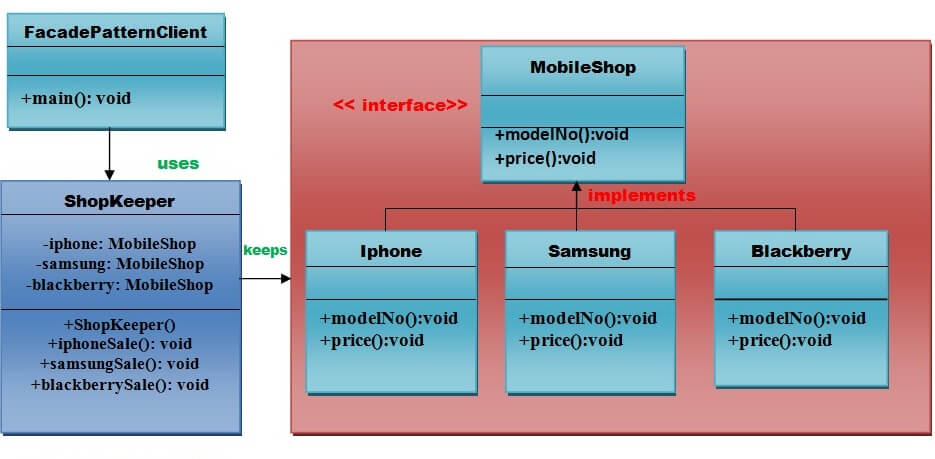
Implementation of above UML:
Step 1
Create a MobileShop interface.
public interface MobileShop {
publicvoidmodelNo();
publicvoidprice();
}
Step 2
Create a Iphone implementation class that will implement Mobileshop interface.
public class Iphone implements MobileShop {
@Override
publicvoidmodelNo() {
System.out.println(” Iphone 6 “);
}
@Override
publicvoidprice() {
System.out.println(” Rs 65000.00 “);
}
}
Step 3
Create a Samsung implementation class that will implement Mobileshop interface.
public class Samsung implements MobileShop {
@Override
publicvoidmodelNo() {
System.out.println(” Samsung galaxy tab 3 “);
}
@Override
publicvoidprice() {
System.out.println(” Rs 45000.00 “);
}
}
Step 4
Create a Blackberry implementation class that will implement Mobileshop interface .
public class Blackberry implements MobileShop {
@Override
publicvoidmodelNo() {
System.out.println(” Blackberry Z10 “);
}
@Override
publicvoidprice() {
System.out.println(” Rs 55000.00 “);
}
}
Step 5
Create a ShopKeeper concrete class that will use MobileShop interface.
public class ShopKeeper {
private MobileShop iphone;
private MobileShop samsung;
private MobileShop blackberry;
public ShopKeeper() {
iphone = new Iphone();
samsung = new Samsung();
blackberry = new Blackberry();
}
publicvoidiphoneSale() {
iphone.modelNo();
iphone.price();
}
public void samsungSale() {
samsung.modelNo();
samsung.price();
}
public void blackberrySale() {
blackberry.modelNo();
blackberry.price();
}
}
Step 6
Now, Creating a client that can purchase the mobiles from MobileShop through ShopKeeper.
import java.io.BufferedReader;
import java.io.IOException;
import java.io.InputStreamReader;
public class FacadePatternClient {
privatestaticintchoice;
public static void main(String args[]) throws NumberFormatException, IOException {
do {
System.out.print(“========= Mobile Shop ============ \n”);
System.out.print(“ 1. IPHONE. \n”);
System.out.print(“ 2. SAMSUNG. \n”);
System.out.print(“ 3. BLACKBERRY. \n”);
System.out.print(“ 4. Exit. \n”);
System.out.print(“Enter your choice: “);
BufferedReader br = new BufferedReader(new InputStreamReader(System.in));
choice = Integer.parseInt(br.readLine());
ShopKeeper sk = new ShopKeeper();
switch(choice) {
case 1: {
sk.iphoneSale();
}
break;
case 2: {
sk.samsungSale();
}
break;
case 3: {
sk.blackberrySale();
}
break;
default: {
System.out.println(“Nothing You purchased”);
}
return;
}
} while (choice != 4);
}
}
Output
========= Mobile Shop ============
1. IPHONE.
2. SAMSUNG.
3. BLACKBERRY.
4. Exit.
Enter your choice: 1
Iphone 6
Rs 65000.00
========= Mobile Shop ============
1. IPHONE.
2. SAMSUNG.
3. BLACKBERRY.
4. Exit.
Enter your choice: 2
Samsung galaxy tab 3
Rs 45000.00
========= Mobile Shop ============
1. IPHONE.
2. SAMSUNG.
3. BLACKBERRY.
4. Exit.
Enter your choice: 3
Blackberry Z10
Rs 55000.00
========= Mobile Shop ============
1. IPHONE.
2. SAMSUNG.
3. BLACKBERRY.
4. Exit.
Enter your choice: 4
Nothing You purchased
